The Knowledge Fragmentation Report
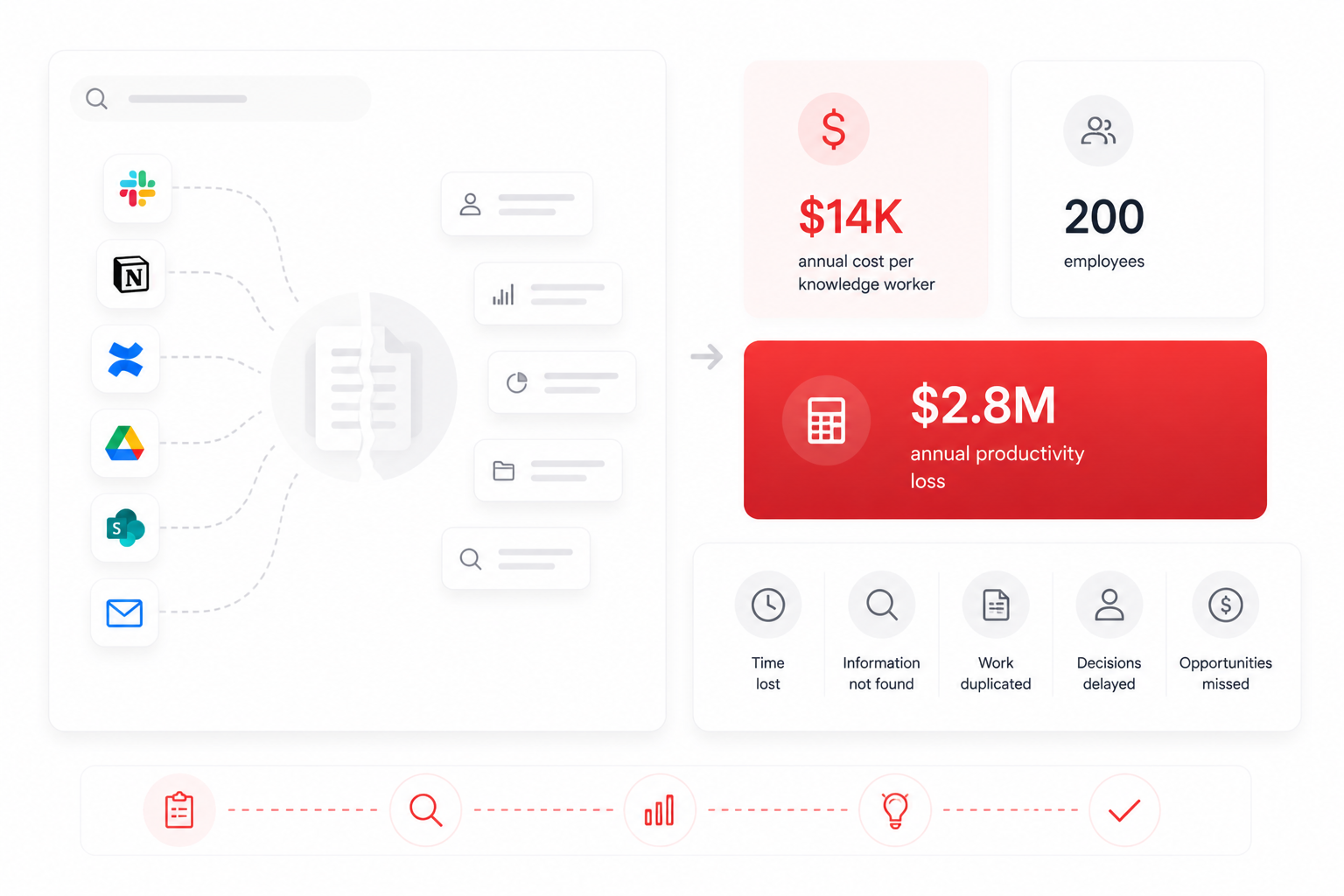
IDC estimates the annual cost of knowledge worker productivity loss due to inadequate information access at $14,000 per employee. For a 200-person organisation, that is $2.8M annually.
Executive summary
IDC estimates the annual cost of knowledge worker productivity loss due to inadequate information access at $14,000 per employee. For a 200-person organisation, that is $2.8M annually. This report examines the structural causes of knowledge fragmentation, identifies the five types of knowledge loss that drive this cost, and provides a diagnostic framework for organisational self-assessment.
1. The $14,000 number — how IDC calculated it and why it is real
IDC's methodology calculates the hourly cost of knowledge worker time, multiplied by hours spent on unproductive information search — searching for documents that exist, asking colleagues for answers that are documented, waiting for responses to questions that should be self-serve.
You do not need to accept IDC's methodology precisely. You need to accept that the cost is real, it is significant, and it is largely recoverable with the right infrastructure.
2. The fragmentation paradox: why more tools make it worse
Knowledge is created where work happens — in Slack, GitHub, email, Google Docs, Zoom call notes, Jira comments. A canonical wiki captures a fraction of the knowledge generated in any given week. The rest accumulates in the tools where it was created.
3. Five types of knowledge loss
Type 1: Tribal knowledge loss
Senior employees become the de facto knowledge index. A senior engineer interrupted three times daily loses approximately 150 hours per year — roughly £12,000–£20,000 of senior time at typical knowledge worker salary levels.
Type 2: Version knowledge loss
The correct answer exists in a document that has been superseded. Employees act on outdated information believing it to be current. The cost is only visible when something goes wrong — an audit exception, a customer complaint, a process failure.
Type 3: Access knowledge loss
The right document exists and is accessible to the right person — but they cannot find it. The most common and most directly addressable form. It requires better search, not documentation improvement.
Type 4: Search knowledge loss
Employees search for information, fail to find it, and stop trying. Tools that cannot be reliably searched become write-only — documents are created in them but never retrieved.
Type 5: Onboarding knowledge loss
McKinsey's research suggests organisations with effectively searchable knowledge reduce new hire ramp time by up to 35%. At a knowledge worker salary of £50,000, a 35% reduction in a 3-month ramp period represents £4,375 per hire in recovered productivity.
4. The cost by department
| Engineering | High tribal knowledge cost from incident response and onboarding. Senior engineer time is the most expensive knowledge index in any organisation. |
| Sales | High search time for battlecards, case studies, and product specs. New rep ramp time is the primary cost driver. |
| People & HR | Moderate-to-high repeat query cost. Version confusion around policy documents is a common failure mode. |
| Finance | Moderate search time with high version confusion risk. Compliance and audit preparation are the most costly failure points. |
| Customer Support | High internal search time mid-ticket. Quality variance between experienced and new agents is a direct product of knowledge accessibility. |
| Operations | Moderate search time with high version confusion risk. SOP currency is a consistent operational failure point. |
5. What unified AI search actually fixes
| Access knowledge loss | Resolves directly. Documents that exist and are accessible are now findable through unified semantic search. |
| Version knowledge loss | Resolves through version-aware retrieval. Results always cite the document version and last-modified date. |
| Onboarding knowledge loss | Resolves significantly. New hires self-serve from day one. |
| Search knowledge loss | Resolves through improved answer quality and natural language query support. |
| Tribal knowledge loss | Partially resolves. Documented tribal knowledge becomes findable. Undocumented knowledge is identified through knowledge gap analytics. |
| Undocumented knowledge | Does not resolve. Knowledge search cannot surface information that was never created. |
Conclusion: an architectural problem requires an architectural solution
Knowledge fragmentation is not a documentation problem. It is not a cultural problem. It is an architectural problem — the consequence of knowledge being created in distributed tools with no unified retrieval layer above them.
The architectural solution is a unified search layer that sits above every knowledge tool, indexes all of them in real time, generates direct cited answers from natural language queries, and surfaces knowledge gaps through analytics. It changes only how knowledge is retrieved.
→ Calculate your organisation's knowledge access score — free 2-minute assessment
Download the full report
Enter your work email to get instant access to The Knowledge Fragmentation Report.