The State of Ecommerce Search 2025
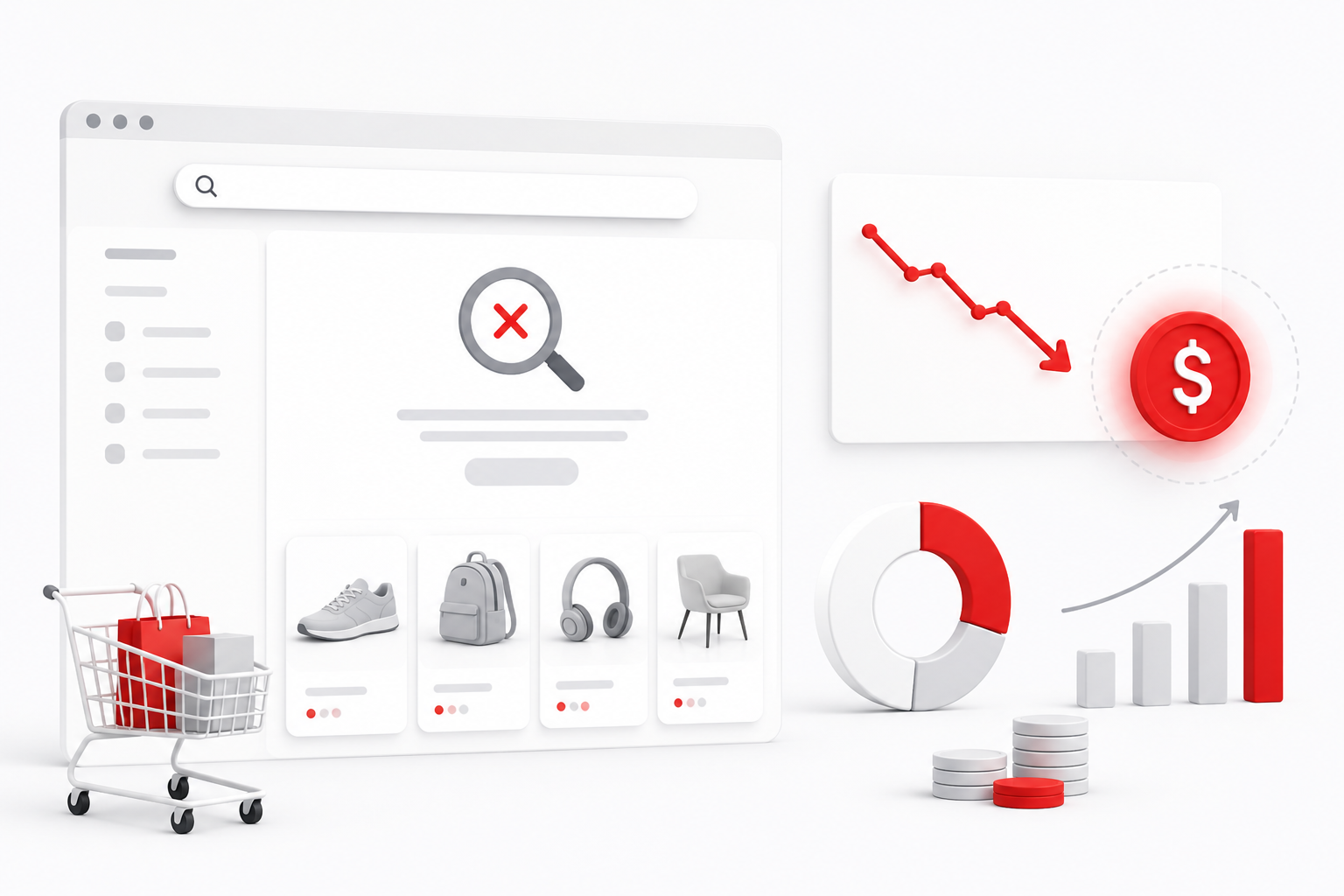
Mid-market ecommerce retailers are systematically under-invested in search intelligence relative to the revenue it drives. The average store loses between $40,000 and $200,000 annually to addressable search failures.
Executive summary
Mid-market ecommerce retailers are systematically under-invested in search intelligence relative to the revenue it drives. Baymard Institute research shows 72% of ecommerce sites fail to support common shopper query types. The average mid-market store loses between $40,000 and $200,000 annually to addressable search failures.
1. The ecommerce search performance gap
There is a significant and growing gap between the search intelligence deployed by enterprise retailers and the search infrastructure used by mid-market retailers. Large enterprise retailers (GMV above $500M) spend meaningfully on dedicated search engineering, third-party search platforms with enterprise contracts, and ongoing search optimisation. Mid-market retailers typically rely on native platform search — tools not designed for search intelligence.
The average mid-market retailer is competing for the same shoppers as enterprise retailers while operating search infrastructure that is 10 years behind them.
2. The five most common search failure modes
Failure 1: Vocabulary gap (estimated revenue impact: 15–25% of search-driven revenue)
The dominant cause of zero-result pages. Shoppers use everyday language; product catalogs use trade terminology. Keyword search cannot bridge this gap. Semantic AI search addresses it structurally.
Failure 2: Absent or inadequate search analytics
Every failure mode is addressable — but only if you know it exists. Most mid-market retailers have no direct zero-result rate monitoring, no search conversion rate comparison against browse, and no revenue attribution at the query level.
Failure 3: Developer-dependent merchandising
Any change to search configuration requires a development ticket. The ticket enters a sprint queue. The campaign goes live late, incompletely, or with reduced scope.
Failure 4: Zero-result page proliferation
Research shows that 40% of shoppers who receive a zero-result page abandon the site rather than reformulating the query. The zero-result page is often the last interaction that shopper has with your store.
Failure 5: B2B attribute search inadequacy
B2B buyers search by technical specification. Standard ecommerce search platforms index product titles as flat text — they do not treat product attributes as first-class search fields.
3. How AI search has changed the economics
Three years ago, semantic AI search was an enterprise-only investment — $100,000+ annual contracts with 6-month implementation timelines. Today, AI-powered ecommerce search is deployable in days at price points accessible to mid-market retailers.
4. A benchmark framework for ecommerce search health
| Zero-result rate | Target: under 3%. Concern: above 7%. Critical: above 15%. |
| Search conversion rate | Target: above 4.5%. Concern: below 3.5%. (Benchmark: 4.63% industry average) |
| Search revenue attribution | Target: tracked by query. Concern: tracked only in aggregate. Critical: not tracked. |
| Merchandising independence | Target: fully self-serve. Concern: some dev dependency. Critical: all changes need dev. |
| Analytics instrumentation | Target: 5 key metrics tracked. Concern: 2–3 tracked. Critical: search term list only. |
5. Recommendations: three actions this quarter
Action 1: Instrument before you optimise
If you do not have zero-result rate monitoring and search conversion rate comparison, implement these first. This can be done with GA4 enhanced ecommerce events and does not require a platform change.
Action 2: Export and classify your zero-result queries
Export three months of zero-result search queries. Classify each one as vocabulary gap, catalog gap, or technical failure. The vocabulary gap queries are your immediate merchandising opportunity.
Action 3: Evaluate semantic AI search against your specific zero-result data
Take your top 20 vocabulary gap queries and test them against a semantic AI search tool. The business case becomes self-evident when you see the gap between what keyword search returns and what semantic AI returns.
→ Calculate your search revenue gap with the SearchSense Commerce free audit
Download the full report
Enter your work email to get instant access to The State of Ecommerce Search 2025.